The Swadeshi movement
Swadeshi was more than a boycott.
A word that has shrunk to a shopping instruction once meant something considerably more demanding: build the capacities of self-rule before self-rule arrives.
The movement
16 October 1905
The Bengal Presidency was, by the early twentieth century, an administrative unit of enormous size — and the centre of Indian political organisation. Under Viceroy Lord Curzon, the government resolved to divide it. The partition took effect on 16 October 1905.
The official case was administrative: the province was too large to govern efficiently. Bengali opinion read a different intention. Dividing Bengal along a line that separated its eastern, Muslim-majority districts from its western ones would split the political class that had made Calcutta the most troublesome city in British India, and would set two populations against each other in the process.
Pal, speaking at Madras in May 1907, made an argument about the partition that is worth quoting because it is not the argument usually attributed to the movement. He said the significance of the measure had been exaggerated outside Bengal — and, he conceded, by part of the Bengali press as well. The partition was an evil measure. But he did not think a line on a map could do what its authors intended.
What the partition actually did, in his reading, was destroy the credibility of petitioning. Bengal had cried, prayed, petitioned and protested, and the administration had proceeded anyway. If argument addressed to the government produced nothing, then political effort had to be redirected — away from the state and toward the society. That redirection is Swadeshi.
It is not in the power of any Government, much less is it in the power of an alien Government, to divide a people whom Gods united.
Bipin Chandra Pal, “The New Movement”
Speeches Delivered at Madras, Ganesh & Co., 1907
How one measure became a movement
Each stage is a response to the failure of the one before it.
01
Partition
The province is divided by administrative order, over sustained public objection. The lesson drawn is not that the objection was wrong but that objection, as a method, does not work.
02
Protest
Public meetings, processions and the mass gathering at the Calcutta Town Hall on 7 August 1905. Protest establishes the scale of feeling but does not, by itself, impose any cost on the government.
03
Boycott
Refusal to buy British manufactures — the first method that carries a price the other side can feel. Pal defended it in explicitly economic terms, as a tariff levied by a people on itself.
04
Swadeshi
A boycott only removes. Swadeshi supplies: indigenous manufacture, cloth, salt, sugar, enamelware, small industry. Refusal becomes production, and protest acquires a material base.
05
National education
Pal treated this as the necessary supplement to boycott: a system that trains young people to earn a living independent of government service and of the professions the state controls. Without it, boycott produces unemployed graduates.
06
Political mobilisation
Village-level co-operative labour, local arbitration, volunteer watch-and-ward. In his fourth Madras lecture Pal described these as a practical demonstration of Indian capacity for self-government — an answer, in action, to the claim that Indians were unready for it.
Swadeshi operated on five levels at once
Reduce it to any one of these and the movement stops making sense.
Political
A method that does not ask permission
Every earlier nationalist method — petition, memorial, deputation — required the government to respond. Swadeshi did not. It relocated political action into decisions Indians could make without consent.
Economic
Protection without a state
Pal argued that regulating consumption was the economic principle underlying boycott, and that this amounted to protective tariffs imposed by a people on themselves — a policy no economist would call unsound if a government had enacted it.
Educational
Schools outside the system
National education institutions were founded to train students in a curriculum connected to Indian life and to livelihoods independent of government employment. Pal gave a whole lecture to the subject.
Cultural
A vocabulary of one's own
Vernacular publishing, song, festival and public assembly gave the movement forms of expression that colonial institutions neither supplied nor controlled.
Social
Organisation at village level
Co-operative labour, local dispute settlement and volunteer corps for watch and ward. Pal described these as a working demonstration that Indians could administer their own affairs.
Boycott, argued as economics
Pal devoted the fourth of his 1907 Madras lectures entirely to boycott. What is striking, reading it now, is how little of it is about anger.
He begins by defining passive resistance: asserting the will of the nation against the wrong that the domination of one people over another inflicts — economically, politically, morally and spiritually — while keeping strictly within the law. The strategic instruction is explicit: keep ourselves in the right, and place those opposed to us in the wrong at every step.
He then makes the economic case. The regulation of consumption, he argues, is the economic principle underlying the boycott movement, and he is prepared to defend it as economic theory rather than protest. Boycott is protection: the imposition of protective tariffs upon the people themselves, and indirectly upon foreign imports. If protection is of economic value — and, he notes drily, no economist outside Manchester has ever declared protection to be wrong — then boycott is too.
He is also honest about its limits. He distinguishes between goods where the boycott was effectively absolute — enamelled articles, foreign cloth, salt, sugar — and goods where it was partial. He calls the work uphill. He notes that a movement without a state behind it has to do by voluntary organisation what a government would do by legislation.
And he had a precedent in mind. He tells his Madras audience about a consumers' league meeting he attended in New York, whose members boycotted the products of firms that mistreated their workers. Pal's boycott is placed, deliberately, in the company of international consumer politics rather than of religious injunction.
Boycott is protection, it is the imposition of protective tariffs upon the people themselves.
Bipin Chandra Pal, “Boycott” (fourth lecture)
Speeches Delivered at Madras, Ganesh & Co., 1907
Note the audience. Pal is not addressing a crowd that needs rousing; he is addressing one that needs convincing, and he does it with tariff theory and an American example. This is what it looks like when a journalist argues rather than exhorts.
Pal's documented role
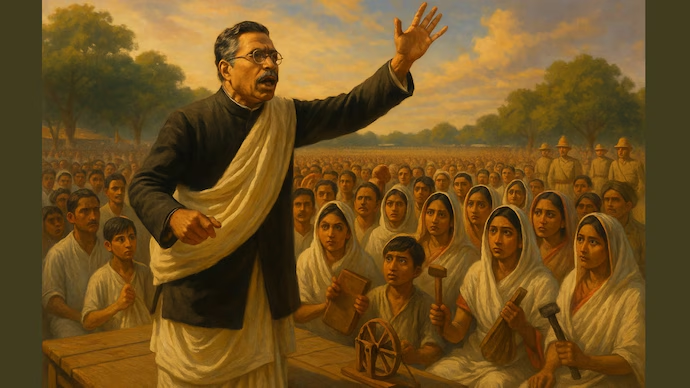
Recreated image. Every other photograph on this site is a historical image, captioned with what is and is not known about it.
What can be said with confidence about Pal's own part in the movement:
He addressed the Calcutta Town Hall meeting of 7 August 1905. He refers to doing so in his Madras lecture two years later, describing the size of the crowd.
He founded Bande Mataram in August 1906, on the movement's first anniversary — giving Swadeshi a daily English-language organ.
He carried the argument out of Bengal. His Madras lectures of May 1907 were delivered at the invitation of southern nationalists, chaired at the first meeting by G. Subramania Aiyer, editor of Swadesamitran. This is how a Bengali provincial grievance became a national programme.
He supplied the movement's theory. More than any other leader of the period, Pal set out in print why boycott was economics, why national education was structural rather than symbolic, and why village organisation was a rehearsal for self-government.
He paid for it with six months in prison in 1907 — not for a speech, but for refusing to give evidence against his own former newspaper.
What the movement left behind
The Swadeshi movement did not achieve its immediate object on its own terms, and it fractured the organisation that carried it. It nonetheless changed Indian politics permanently.
The partition was annulled in 1911 — six years after it was imposed, and after the movement's peak had passed. Historians differ on how much of that reversal to attribute to the agitation and how much to the administrative and imperial calculations of the time. The disagreement is genuine and this site does not settle it.
What is not in dispute is the change of method. Before 1905, Indian nationalism was overwhelmingly a politics of petition conducted by professional men. After 1905, it possessed a repertoire — boycott, parallel institutions, mass meeting, economic pressure — that could be picked up and used by anyone. Gandhi's movements after 1919 were built with tools forged in this decade.
The costs were real too. The Congress split at Surat in 1907 between the two wings. Repression intensified. And the communal dimension of the partition — a Muslim-majority eastern province set against a Hindu-majority western one — left a fracture that later politics would widen.
The event
The annulment of 1911
The Partition of Bengal was reversed in 1911. The province was reunited on linguistic lines, with the capital of British India simultaneously moved from Calcutta to Delhi.
The idea
Why the reversal did not settle the argument
Pal's case was never that the partition line was the problem. It was that a people whose fate could be decided elsewhere had to build strength that did not depend on such decisions. On that reading, annulment proved his point rather than answering it: the same authority that had drawn the line erased it, and Indians were spectators to both.
Continue to Lal–Bal–Pal, where the split at Surat and the differences between the three leaders are set out in detail.
Sources for this chapter
- Bipin Chandra Pal, Speeches of Bepin Chandra Pal, Delivered at Madras (Madras: Ganesh & Co., 1907) — the six lectures of 2–9 May 1907, including “The New Movement”, “Boycott” and “National Education”. Quotations transcribed from the digitised printed volume.
- “Pal, Bipin Chandra”, Banglapedia — on the founding of the Bande Mataram daily following the 1905 partition and Pal's propaganda tours.
- “Note on the Texts”, Bande Mataram: Political Writings and Speeches 1890–1908 — for dating the founding of the daily to 6 August 1906.
Historians' assessments of how far the agitation caused the 1911 annulment differ. That disagreement is described above as a disagreement, not resolved.